I have to admit, writing the title of this post just now made me think "Bears. Beets. Battlestar Galactica."
But back to Colorado...
As you probably know, we like to brew beer. In fact, this is what our kitchen looked like Sunday night:
and what Kate's closet has in it right now:
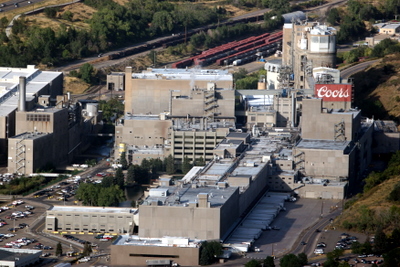
So while in the area, we thought visiting the Coors brewery in Golden, CO would be a fun way to spend an afternoon. It's a massive concrete and plumbing-filled complex, and was interestingly different than the micro and craft breweries we've toured before. For example - there are train tracks leading directly into the building so the loads of grain coming from the fertile midwest can be delivered literally straight into the mash tuns. And instead of one or two or maybe a handful of fermenters, they've got a forest of giant copper kettles for brewing all the varieties Coors makes.
The self-guided audio tour was pretty fun, and gave a good, simple overview of the brewing process. At one point, however, there was a display showing how Coors uses "only the freshest, natural ingredients" for their beers or something, and had some bins of said ingredients for tour goers to touch/smell. The bins contained 1) Barley, 2) Hops, 3) Corn. Eek! Corn! They're advertising that they throw a bunch of corn in their beer to get the sugar needed instead of getting it from malted grains like real beer is supposed to!? Yechk.
Soon after the fermenting area we came to a little serving window. We thought this was the only tasting opportunity, but it turned out only to be a "mid-tour" tasting room with the selection limited to two choices. Kate opted for "bad" while Tom picked "slightly less bad." Mmmm... taste that corn!
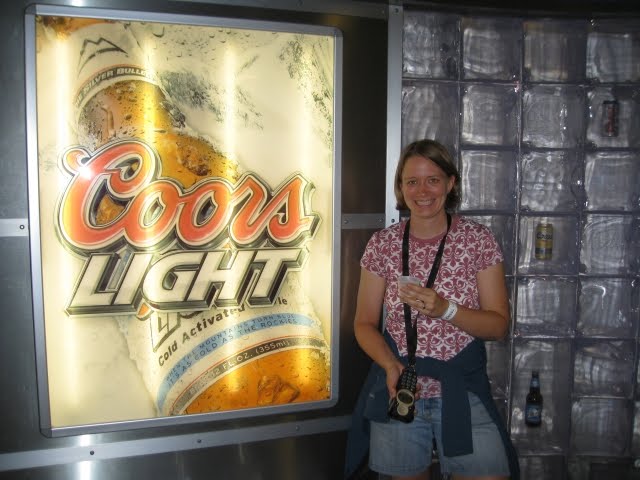
Fortunately there was more after this refreshing pit-stop. We were lucky to see the packaging room in action, with cans of Keystone being mechanically corralled into 12-packs and then being whisked every which way on a maze of conveyor belts and tracks. Pretty cool to see from an operations perspective. A lot of technology in that room to make sure college students around the country have cheap beer with which to play pong.
Finally we arrived at the tasting room, which was basically a bar. We had wristbands that entitled us to 3 drinks each (!), and these were good 8-10 oz. glasses too! After getting here we realized why they mention at the beginning, "Please, only one tour per day" (it's free). To their credit, they had a couple of reasonably interesting Colorado-only smaller batches that were more craft-style beers than the watery Coors Light most people associate with the brand. And despite their corporate overlords, I still enjoy Blue Moon and much of that family. And they do have a lot of neat sustainability efforts going on in the giant Golden, CO plant. I think overall the best part was arriving at the facility and realizing that, although we were outside on a windy summer afternoon, it smelled like our kitchen does on brewing day.
Well, that got longer than I had intended! The bucking broncos will have to wait another day...
Showing posts with label Brewing. Show all posts
9.14.2010
8.07.2009
From Belgium with Love
We just racked (or transferred) the wort (or unfinished beer) into secondary (or a separate jug) yesterday to help it clear and keep it off the dead yeast cells, and in doing so I definitely got strong aromas of blackberry and pepper, in line with the distinctive Chimay Grande Reserve flavors. We'll be sure to let you know how it turns out in a month or so.Maybe some day we can have a taste test with Steve and Sarah, who I'm happy to hear have just started homebrewing themselves! In the meantime, what should we make next? Does anybody have any other favorite commercial beers that we should try to clone?
12.05.2008
Dec. 5 - Happy Repeal Day
Currently on tap (in bottles, technically) at our house:
Recipe: Waggin' Tail Pale Ale
Malt Extracts:
6 lbs ultralight LME
Grains:
1 lb American Pale Malt
1 lb Crystal 40
.5 lb Crystal 20
.5 lb American Vienna
.5 lb American CaraPils
Hops:
.5 oz Centennial (60 min)
.5 oz Cascade (60 min)
.5 oz Cascade (40 min)
.5 + .25 oz Cascade/Amarillo (15 min)
.5 + .25 oz Cascade/Amarillo (3 min)
Yeast:
California Ale – WLP001, pitched into fermenter at 78 deg or so.
Brewing date: 10/25/08
Bottling date: 11/14/08
OG: 1.047
Fermentation temperature: 70-65
Fermentation time: 3 weeks
FG: 1.011
% alc: 4.7%

4.29.2008
The Brewery
You may remember from an earlier post that we started brewing our own beer this year, after getting the necessary equipment as a Christmas gift from Kate's brother, Mark. It's been really fun so far brewing (and drinking) the three batches of beer, along with the batch of hard cider (that's Kate's favorite). To date, we have made:

Our latest creation, the hefeweizen, has the opposite problem - it's already carbonated after only 5 days in bottles! I'm hoping I didn't add too much priming sugar (which creates the carbonation in the bottles) - because this wheat beer had a lot of trub in the fermenter, we ended up with less than the expected 5 gallon batch size, so I had to scale down the standard 3/4 cup of priming sugar accordingly on the fly. Hopefully we won't have any future posts describing the exploding bottles in our hall closet. I'm encouraged about the hefe because even after a short time in bottles it has a nice full, smooth flavor with noticeable honey/wheat taste, but none of the banana or citrus that we don't really like in most commercial hefeweizens. Since I can't fully justify drinking two beers tonight just to enhance the multimedia aspect of this blog post, I'll just give you the picture of this one from when we were measuring the alcohol content of the hefe, which turns out to be 5.7% (by vol), incidentally.
The next batch on the docket is a red/amber ale recipe I found online that's received rave reviews from other homebrewers called "Fire in the Hole." I'm not exactly sure how it got that name, but I'm hoping it lives up to its billing! Come visit and we'll treat you to a pint or two.
- an American Brown Ale (think Newcastle but more delicious)
- a Brown Porter (not quite as dark and potent as normal Porters)
- Hard Apple Cider (with a chardonnay yeast)
- a German Honey Hefeweizen

Our latest creation, the hefeweizen, has the opposite problem - it's already carbonated after only 5 days in bottles! I'm hoping I didn't add too much priming sugar (which creates the carbonation in the bottles) - because this wheat beer had a lot of trub in the fermenter, we ended up with less than the expected 5 gallon batch size, so I had to scale down the standard 3/4 cup of priming sugar accordingly on the fly. Hopefully we won't have any future posts describing the exploding bottles in our hall closet. I'm encouraged about the hefe because even after a short time in bottles it has a nice full, smooth flavor with noticeable honey/wheat taste, but none of the banana or citrus that we don't really like in most commercial hefeweizens. Since I can't fully justify drinking two beers tonight just to enhance the multimedia aspect of this blog post, I'll just give you the picture of this one from when we were measuring the alcohol content of the hefe, which turns out to be 5.7% (by vol), incidentally.
The next batch on the docket is a red/amber ale recipe I found online that's received rave reviews from other homebrewers called "Fire in the Hole." I'm not exactly sure how it got that name, but I'm hoping it lives up to its billing! Come visit and we'll treat you to a pint or two.
2.11.2008
Brewmeisters
My brother Mark (and his wife Catherine) gave Tom and me a gift certificate for a beer making setup for Christmas this year. It was an appropriate gift - Mark was into home brewing himself when he was about our age. Unfortunately, after 3 or 4 successful batches, Mark read somewhere that adding pine extract to beer would make a nice Christmas brew. In actuality it made a beverage that bore an uncanny resemblance to pine-sol. Mark hasn't brewed since.
Aaannnyyyways, Tom and I aren't serious beer connoisseurs, but the chemistry and the do-it-yourself aspect definitely appeals to us. So we got a very nice kit from our local homebrew store, and decided to start with a batch of American Brown Ale. The first task was to accumulate 50 brown pop-top beer bottles. We had to throw a poker party a couple days before brewing to make sure we'd have enough. Then, we spent a long Friday night a couple of weeks ago brewing it up. When we were done, we nestled 5 gallons of precious yeasty mixture into our closet where it would stay warm and dark.
After three and a half weeks of fermentation in the closet we finally decided that it was done and ready to bottle. Tom was actually out in DC when it was time to bottle, so I had to schlep the 5 gallons around the house and figure out how to add the carbonation sugar on my own. Fortunately, Dustin showed up just in time to help me bottle the mixture - clamping the tops on all those bottles isn't a particularly easy task.

Last week, we popped open the first "test" bottle of brew when we had a few friends over. It got good reviews overall - it was nice and full and surprisingly hoppy. It had started to carbonate but wasn't quite ready to go yet, so we've put the bottles back in the closet to finish up.
With one batch of beer in the works, we decided to try our hand at something a little different - hard cider. It is tough to find a good set of directions for making hard cider; none of the libraries carry any literature and on-line material varies wildly from site to site. We ended up just quizzing the brew-store owner about how to make it, and we are hopeful that his verbal directions will work for us. Cider is a particular challenge because most commercial cider has a fair amount of sweetness to it. This is very tough to achieve for a home brewer, because any sugar that is left in the cider when you bottle has the tendency to over-carbonate and explode. So we'll likely end up with a very dry cider (despite using some very sweet gravenstein apple juice with 2 lbs of added honey), but we're hoping it tastes good anyway.
As we speak, the cider is perking away in its five gallon carboy in our closet! Cider takes a lot longer than beer to finish, so we aren't likely to be drinking any for at least two months, but it's fun and exciting to try something new!
Aaannnyyyways, Tom and I aren't serious beer connoisseurs, but the chemistry and the do-it-yourself aspect definitely appeals to us. So we got a very nice kit from our local homebrew store, and decided to start with a batch of American Brown Ale. The first task was to accumulate 50 brown pop-top beer bottles. We had to throw a poker party a couple days before brewing to make sure we'd have enough. Then, we spent a long Friday night a couple of weeks ago brewing it up. When we were done, we nestled 5 gallons of precious yeasty mixture into our closet where it would stay warm and dark.
After three and a half weeks of fermentation in the closet we finally decided that it was done and ready to bottle. Tom was actually out in DC when it was time to bottle, so I had to schlep the 5 gallons around the house and figure out how to add the carbonation sugar on my own. Fortunately, Dustin showed up just in time to help me bottle the mixture - clamping the tops on all those bottles isn't a particularly easy task.
Last week, we popped open the first "test" bottle of brew when we had a few friends over. It got good reviews overall - it was nice and full and surprisingly hoppy. It had started to carbonate but wasn't quite ready to go yet, so we've put the bottles back in the closet to finish up.
With one batch of beer in the works, we decided to try our hand at something a little different - hard cider. It is tough to find a good set of directions for making hard cider; none of the libraries carry any literature and on-line material varies wildly from site to site. We ended up just quizzing the brew-store owner about how to make it, and we are hopeful that his verbal directions will work for us. Cider is a particular challenge because most commercial cider has a fair amount of sweetness to it. This is very tough to achieve for a home brewer, because any sugar that is left in the cider when you bottle has the tendency to over-carbonate and explode. So we'll likely end up with a very dry cider (despite using some very sweet gravenstein apple juice with 2 lbs of added honey), but we're hoping it tastes good anyway.
As we speak, the cider is perking away in its five gallon carboy in our closet! Cider takes a lot longer than beer to finish, so we aren't likely to be drinking any for at least two months, but it's fun and exciting to try something new!
Subscribe to:
Posts (Atom)